Sunday, June 2, 2013

Muscles of the Arm


The muscles of the torso are often thought of as chest and back muscles, when in fact most, other than the obliques and the abdominals, are really muscles of the arm.

I've posted these diagrams that I've begun to prepare for my anatomy master classes this summer in order to help others who find this area confusing.   All these muscles coming off the ribcage and the scapula can seem confusing, and though not without complexity, are not that hard to understand.

Once again I emphasize the need to know the skeleton since once you understand the origins and insertions of the muscles as cables, then no matter where you position the arm, it becomes self evident how the form should follow.

More about future anatomy workshops  this summer to follow shortly.

Feel free to copy these images for your use.  


Wednesday, May 29, 2013

Gestural Elegance of a Tree stump.

They may just be trees or stumps but for me there is as much learning in them as in the study of a leg or arm.  Beautiful form, structure, flow and rhythm. 

Years ago I would take my Sheridan Animation students to draw a beautifully gnarled rotting beech trunk. It had as much expressive gesture as the best model.

These studies were done with my Humber Animation students at the nearby Arboretum.  Same lesson to be learned by all of us.


Saturday, April 13, 2013

Another day at the ROM

No end to the subjects to draw there. My only frustration is that I can't move around the specimens.   Yesterday was studies of fox and wolf for up-coming book.

Saturday, February 16, 2013

Day at the Royal Ontario Museum

Assorted studies and doodles done for students


 Had a day at the Royal Ontario Museum with my Humber  College students yesterday.  It made me realize that if only I lived closer I would be there almost every day.  There are simply so many wonderful and fascinating things to study and draw, from armour to amazing animals.


Grizzly cub

I admit that while I am fascinated by the myriad of animals, reptiles and birds there is a part of me that feels sad that so many were killed to create these collections.  The only comfort I hope to get other than the opportunity to study them closely is that perhaps if we become more aware of the diversity we can try to preserve them from extinction through our own explosion over the planet.  It's only a hope but that's better than nothing. 


Samurai uniforms

Wednesday, August 29, 2012

New Semester Begins

I'll be busy this fall with teaching at two colleges: Seneca & Humber.  At both I'll be giving classes in Life Drawing as well as mentoring an illustration course on Children's Books at Seneca.  I'm excited about all of it but a bit apprehensive about how much time and effort they will take to execute to the level I wish.

One could give only one course and have your complete time absorbed since as you teach you're also learning things you weren't aware of,  discovering new things to share with your students as well as ever evolving your approach, understanding and delivery.  I've never given the same course twice as hard as I may try to nail it down.  This applies even to the same course given twice in the same day.  But it makes life interesting never the less.

I've posted a drawing of gestures since the depiction gesture is ultimately the true focus of any life drawing course as I see it. Gesture is life: it is expression, attitude, pose, thought caught in a moment, as well as any  action or inaction as it holds for a moment before moving on.

The beauty of animation, and the reason I feel it is such a priviledge to be part of an animation faculty is that animation is life.  Anything can have life in the mind and hands of an animator.  An object like a cube, or a flour sack, or anything at all, can come to life. It can move and better still make us believe that the thought behind that movement is coming from the object.  It has atitude, emotion and a story.

Ultimately that is the challenge of life drawing: to distil life into gesture.

Wednesday, August 22, 2012

Artists I wish I knew about when I was young.


Artists I wish I knew about when I was young.


Many times in teaching I’ve mentioned artists’ names only to see blank looks on my students’ faces.   Rather than be frustrated by this lack of awareness, I remind myself that I too once was unaware of these artists who would so greatly influence my life and work.   

I still remember clearly the day a friend showed me a book of Andrew Wyeth’s work at the U of Guelph library and how deeply his drawings and paintings impressed me.  And the same went for on for many other names and styles that I came across in studies at Guelph as well as discovering since.  Each day new names and works come to my attention, of artists from long ago as well as contemporary. Such is the beauty of the ease of Internet searches, Facebook friends’ offerings, and of course books I can’t cease buying.   

Never the less, there are a few that I think most art students should be aware of for, amongst many things,  their superior drawing abilities.

So I’ve decided to put together a list of artists.  By no means is it meant to be complete and all-encompassing list nor meant to be a survey.  With today’s easy access to collection, museums, and bios as well as images on the web, it takes very little effort to find their work and explore others.   I hope this will encourage more exploration beyond the realms of Manga and comic art**.

As to this list,  they’re simply some of the ones that I’ve found interesting and influential.  I’ve put in quick links to their drawings for a quick tour, but encourage you to get to know them and their times better.

So here goes in no particular order. Once again, all are chosen for their superior drawings and graphic abilities:

Antoine Watteau    his drawings captivate and fascinate me.  ‘his line has an electric fleetness’


Francois Boucher  expert draughtsmanship in a playful line.  Simple yet powerful  


Daumier  


Pieter Breugel  what a mind, what an imagination!

Rubens  I am simply in awe of his drawings. Truly a giant.


Rembrandt   to me, his studies of life on the streets is what café is all about.  His quick pen lines tell a thousand stories in one stroke.  

Gericault (his studies of horses) Stunning studies

Delacroix  fascinated by his anatomy studies and sketch books of his travels.  Another café great

Degas   sensuality in line, tone and colour.  


Raphael   Can’t think much to say other than devine intervention.

Gustav Klimt  Beautiful sensual studies.

Egon Schiele  Intense drawings of the figure.

Heinrich Kley   Amazing ability, simply put.  I can see how he would have influenced animation.

Vincent Van Gogh   Power of creativity and soul behind his lines.


Adolf Von Menzel  beautiful drawings unfortunately considered academic but to me full of life.


Hans Holbein the younger  for the clarity of line and power of sight (attributable to the lens according to David Hockney in his book Secret Knowledge) 


Kathe Kollwitz for the intense humanity and powerful force of her work.


John Singer Sargent for the beauty of all of his paintings and the strength of his drawings.


Bernini for the power of gesture and expressive force of his sculptures.


Of course Michelangelo and Leonardo   No need to say much about them.

This is the list that comes to mind. I am sure I have missed many names that will come to me later. But these are the giants I look to in awe and try to learn from.
Enjoy.


**in no way is this meant to disparage comic or manga artists; rather it is meant as an encouragement to  young artists to explore beyond those styles and look into the artists and works that preceded them.  They may be surprised to see the similarities in expression and storytelling.

Tuesday, July 10, 2012

Course in Human Anatomy


Master Class in Human Anatomy
July 23 - 27


Guelph Ontario


Focus:
This course is designed to give you an intensive overview of the muscles that move the figure, and thereby affect the form and give rise to expression. 

Focus will be given to reading the anatomical structure of the human body through landmarks and changes in form based  study of muscles in movement.

Full body will be covered.

One full day at the Human Anatomy Lab at the University of Guelph.

Course includes model each day excluding the  full day at the Gross Human Anatomy lab at the University of Guelph

Model: Ed Cz

Limited to 7 students

Fee: $599. CAN +HST 

Prerequisite: previous life drawing experience at a mid to high level.
(Previous anatomy study or familiarity an asset but not prerequisite.)
Length of Course :5 days 32.5 hrs 9:30 a.m. – 5 p.m. (less1 hour break for lunch)


(Full day at Anatomy Lab only: $125. July 25) 


for more info, please feel free to email me at werner@wernerzimmermann.ca or through this blog.


Monday, June 18, 2012

Thoughts on Line Quality


Rembrandt study of an elephant, British Museum


This post comes from a reply I wrote this evening to a question from one of my students who asked in response to my previous comment about his work what is line quality.  I thought I would post it since this is probably one of the most common questions, and a valid one too.  I've posted a drawing by Rembrandt and will explain the reason why at the end.

Here goes...my thoughts on what is line quality:

Line quality is something that comes  when the line is connected not to the mind but to the heart.  I know that may sound wacky but it’s not something you can think too much about when you are drawing.  There are no rules except not to think it too much. 

Line has to respond to how you feel about what you are drawing.  Line is descriptive but also expressive.  You can draw a circle or you can express something about the circle. One is info, the other is art.  I’m sure you are cringing as you read this thinking WTF?   

For a moment I’m going to ask you to think:  what are the qualities of line. Line is just a series of either tightly or loosely connected dots.  It can delineate a division of space: this and that side of line.  Or it can enclose a space and define a shape.  It can, like sound, grab your attention with its intensity or be as soft and almost ephemeral as a soft sound.  Think of music.  Music has direction, rhythm and depth.  Line too.  It’s very abstract…it doesn’t exist in reality but is incredibly powerful in art.  It takes the eye in a direction; can set a speed of observation: make you move or stop or hesitate;  can set up a rhythm of observation, and even imply depth where there is none…ie paper.

So where and when does one use all these qualities?  Simple answer….when you feel they are needed.  I am sure at this stage you are, as we all did when starting to really draw and improve our skills,  desperately trying to get it right: make it look like a figure.   It’s a valid and important goal: connecting the eye to the hand.

But while you are doing that don’t leave your heart out of it.  Learn not only to depict, but to express. One is diagram, the other is art.  Diagrams inform…Art communicates feeling, thought, ideas.  Line does it very well.

Give it a try.  It takes a lot of messes to get it right.  I think it was the creator of Bugs Bunny and Road Runner who said you have to get your 500 bad drawings out of the way.  How far are you?


So that was my email to him this evening.  And now, why Rembrandt's elephant?  I came across it the other evening while looking once again at Rembrandt's amazing sketches.  True cafe, or street drawing: full of life, expression, observation...a direct connection between the eye and hand by way of the heart.  

This elephant study doesn't find itself into any of his paintings. It was done only out of interest and  probably empathy.  Each line does more than depict something about the elephant. Each line expressed what Rembrandt felt about what was before him.  The lines vary in length, thickness and intensity in response to a bent back, a curled trunk, a heavy leg or a thinking eye.  We not  only see what an elephant looks like, we feel what an elephant feels and the connection between the artist and the subject throughout.  Behind the elephant a family (perhaps) is mentioned with a few flowing lines.  We know what is important.  And it's only line...a series of variously connected dots that do all this.  

That is the magic of line.  That is what makes it so wonderful and often frustrating to pursue.

Tuesday, June 28, 2011

Anatomy Course Moved to Guelph Studio


We didn't hit the magic number needed to run it at Seneca, but the course lives on out of my studio in Guelph.

Course outline remains the same: same great model Ed, same visit to University of Guelph Anatomy Labs Tuesday and a beautiful place to run it in - Guelph!

Contact me to enroll and for any details: werner@wernerzimmermann.ca


See you in Guelph!

Wednesday, June 22, 2011

Drawing Day June 22


Ed's left knee remained for the most part in the same place; Ed pivoting from front to back over it.


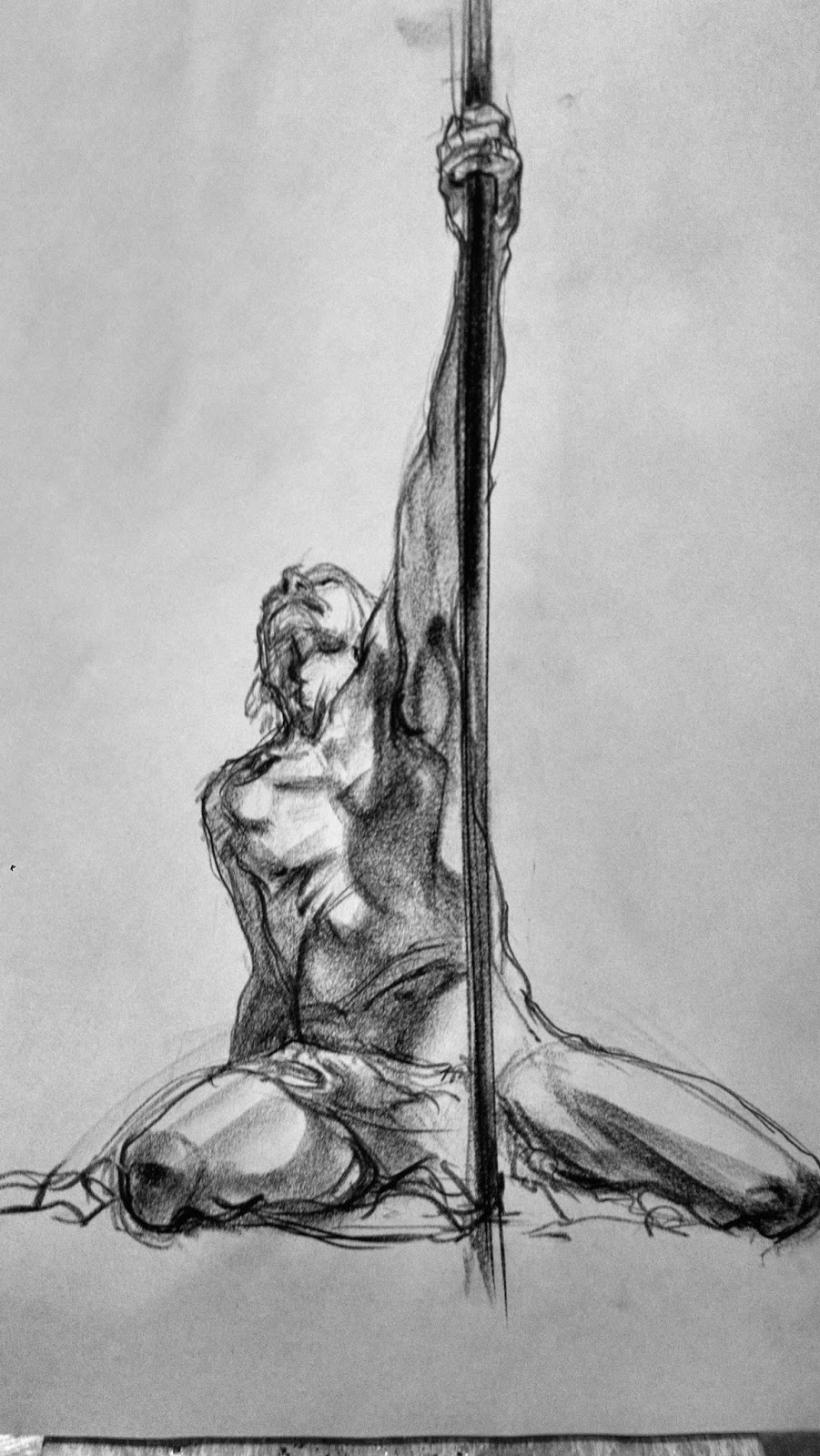
Played around today with overlying sequences, and studies of the back and arms in an extreme pull. Compressed Charcoal on Arches 88 top and middle. Bottom 7B Stabilo pencil on Arches 88

Wednesday, June 1, 2011

Master class in Human Anatomy

Here it is, finally posting. please pass it on to anyone in the arts or industry who you may feel would be interested in an intensive course in human anatomy.

for more info, please feel free to email me at werner.zimmermann@senecac.on.ca, werner@wernerzimmermann.ca or through this blog.


Master Class in Human Anatomy

July4 - 8 2011

Focus:

This course is designed to give the student an intensive overview of the muscles that move the figure, and thereby affect the form and give rise to expression.

Focus will be given to reading the body through landmarks and changes in form based on anatomical insight.

Fee: $599. CAN +HST

Prerequisite: previous life drawing experience at a mid to high level.

(Previous anatomy study or familiarity an asset but not prerequisite.)

Length of Course :5 days 32.5 hrs 9:30 a.m. – 5 p.m. (less1 hour break for lunch)


Course outline:

Monday July 4 - Day 1: Studio with model

overview of the body as form influenced by muscles

  • skeletal study and relationship to landmarks
  • muscle trains
  • planes and their origins
  • overview of muscles that move the major joints
  • Muscles of the waist, neck and face
Tuesday July 5 - Day 2:

  • Full day of study in the Gross Human Anatomy Labs at University of Guelph

(Participants will be responsible for their own transportation to the University of Guelph. Go Bus available from York University or Downtown terminal.)

Wednesday July 6 – Day 3: Studio with model

· Muscles that move the arm from shoulder to finger tips

Thursday July 7 – Day 4: Studio with Model

· Muscles that move the legs from pelvis to toes

Friday July 8 – Day 5: studio with model

· Review and overview of figure

· study of interrelated planes & landmark review

· form changes due to movement

Materials:

· Newsprint 18 x 24 pads for studio work

· Drawing pad 16 x 20 for anatomy lab

· High quality tracing paper

· Conte B & 2B

· pencils 2 4 8B, pencil crayons assorted colours

· Journal or notebook

Each student will be provided with a model skeleton in kit form for daily homework: application of muscles in plasticine.


Werner Zimmermann

is a life drawing instructor at Seneca College to animation students. He taught at Sheridan College in the Animation Program from 1986 to 2001. Zimmermann’s years of teaching and illustrating have given him a unique insight into relating life drawing and anatomy to the needs of animation and illustration. His classes are renowned for the level of information and skills he shares with his students and his teaching methods have been rated by students as outstanding.

Professionally he had been an exhibiting artist and an award winning children’s book author and illustrator.


To enroll: Werner@wernerzimmermann.ca


Arm Studies June 1


One of today's studies: 7B pencil on 9.5 x 17 mat board

Friday, May 27, 2011

Back to Anatomy


For two weeks now my plans to have the amazing model Ed Cz, who many of you will know from Seneca and Sheridan fell through. First I screwed up my schedule and then Ed's starter wouldn't start and he was stuck on the shores of Huron (I can't blame him for wanting another day at his place out there).


Ed's been at my studio and home many times for hours of studies and has inspired some of my best works. This time I wanted to get ready for the Master Class at Seneca for the first week of July and Ed's the best model to prepare from. Not having him in person, I went back to the piles of studies I have done. There is a lot to be learned from returning to old studies, re-interpreting them, taking poses and rotating or changing expression. Even scribbles can be valuable in that they will make you question what you were trying to say, whether or not you got it across, and whether or not you even knew what you were doing.

I found some studies of the back. Of course any part of the body is fascinating, but the back in particular, with its subtle forms created by all the overlying muscles that in many ways are simply muscles of the arms fascinates me in particular. Arms proper, usually thought of as from the shoulder down, and legs are much easier to depict, but usually the back is avoided or rushed over by students. I myself found the back confusing and frustrating until I understood it from the bones up, skin last.

I threw some tracing paper over the study and began to search out the skeleton, when it struck me I hadn't been up to the Anatomy Labs at the University in a while. So that is where I found myself a few minutes later. Unfortunately for me and studying the back, Students from Humber were there working on the cadavers so I moved into a corner, was provided with some arms and spent a few happy hours studying and sketching.


I'm looking forward to the first week in July when I will be bringing my master class students to Guelph for a day at the lab.